





Our Services


Effective Speech and Language Therapy Children

See How We Help Children With Speech, Language, and Reading

ORAL MOTOR SKILLS

Oral motor development refers to the use and function of the lips, tongue, jaw, teeth, and the hard and soft palates. The movement and coordination of these structures is very important in speech production, safe swallowing, and consuming various food textures. Normal oral motor development begins prior to birth and continues beyond age three. By age four, most children safely consume solids and liquids without choking.


Pragmatic (Social) Language

Pragmatic language refers to the social language skills that we use in our daily interactions with others. This includes what we say, how we say it, our non-verbal communication (eye contact, facial expressions, body language etc.) and how appropriate our interactions are in a given situation.

Pragmatic skills are vital for communicating our personal thoughts, ideas and feelings. Children with difficulties in this area often misinterpret other peoples’ communicative intent and therefore will have difficulty responding appropriately either verbally or non-verbally. (https://www.sensationalkids.ie/what-are-pragmatic-language-skills/)

Examples of pragmatic skills:

• Conversational skills
• Asking for, giving and responding to information
• Turn taking
• Eye contact
• Introducing and maintaining topics
• Making relevant contributions to a topic
• Asking questions
• Avoiding repetition or irrelevant information
• Asking for clarification
• Adjusting language based on the situation or person
• Using language of a given peer group
• Using humor
• Using appropriate strategies for gaining attention and interrupting
• Asking for help or offering help appropriately
• Offering/responding to expressions of affection appropriately
• Facial expression
• Body language
• Intonation of voice
• Body distance and personal space


Auditory Processing

Children with APD have trouble hearing and interpreting the message. It is different from hearing loss or deafness. Children with APD:

- May have normal hearing

- Do not correctly process or interpret what they hear

- Have trouble hearing the differences between sounds in words. This can happen even when the sounds are clear and loud enough to be heard.

- May have more trouble when in a noisy area

An audiologist evaluates APD. (cincinnatichildrens.org)

Auditory processing disorder (APD), also known as central auditory processing disorder (CAPD), is a hearing problem that affects about 5% of school-aged children.

Kids with this condition can't process what they hear in the same way other kids do because their ears and brain don't fully coordinate. Something interferes with the way the brain recognizes and interprets sounds, especially speech.

With the right therapy, kids with APD can be successful in school and life. Early diagnosis is important, because when the condition isn't caught and treated early, a child can have speech and language delays or problems learning in school.

Reading (Decoding and Comprehension)

Many children who struggle with speech and language difficulties also have trouble with the acquisition of literacy skills. Articulation deficits, for example, may impact a child’s phonemic awareness (the ability to recognize and analyze the sounds in words), which is a vital component of learning to read. Children who have difficulty recognizing different syllables and sounds may have trouble sounding out words as they read. Delayed language development may also contribute to a limited vocabulary which can cause difficulty with reading comprehension. In school, these students often have difficulty with reading and demonstrating their understanding of material to teachers, both verbally and in writing.

Since spoken language provides the foundation for the development of reading and writing, it makes sense that instruction in spoken language, or speech-language therapy, may result in the growth of a child’s reading and writing skills. The early support of a speech language therapist can impact a child’s development of basic literacy skills in areas such as phonemic awareness, reading fluency, vocabulary development, and reading comprehension.

On-going reading and writing problems may contribute to an older student’s difficulties in using language strategically to communicate, think, and learn. Speech therapists have specialized knowledge and the experience needed to identify communication problems and to provide the help that children need to build critical language skills so that they can be successful in school. (http://exlcentre.com/how-speech-and-language-affects-your-childs-reading/)

Written Expression / Spelling

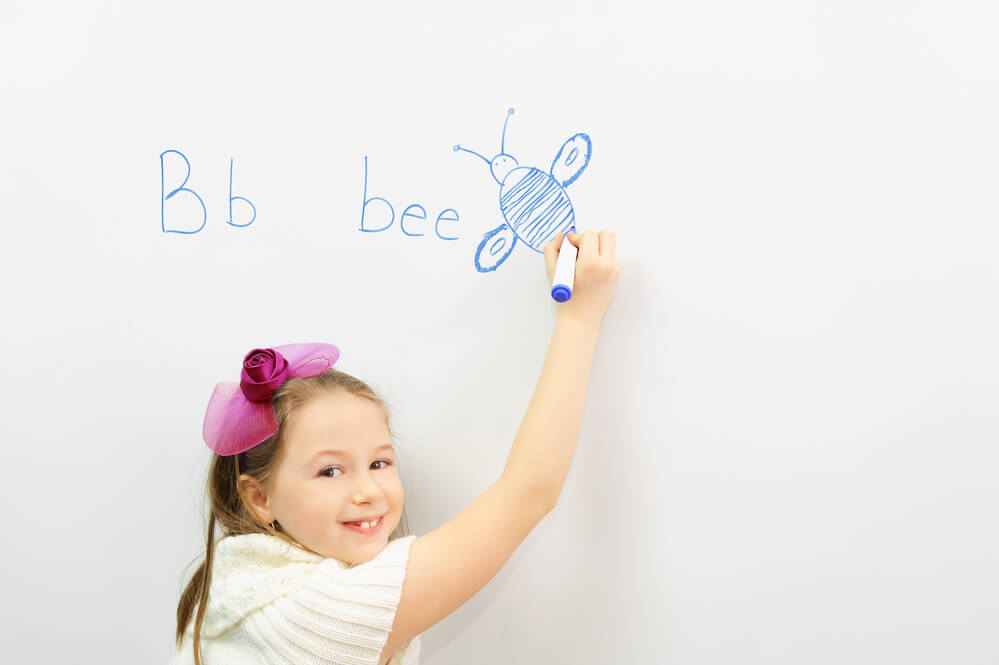
Learning to spell helps a child to develop a strong connection between the letters and their sounds and learning high-frequency ‘sight words’ (i.e. words that can not easily be sounded out) will assist a child in both their reading and writing. The more thoroughly a child knows a word, the more likely it is that they will be able to recognize it in unfamiliar texts, spell it and use it appropriately in their own speech and writing.

What are the building blocks necessary to develop spelling?

Articulation: Clarity of speech sounds and spoken language. A child needs to be able to say a word correctly in order to be able to write it. If a child cannot articulate a particular sound they may end up writing the word the way in which they say it (e.g. if a child says a ‘w’ instead of an ‘r’ they might write ‘ring’ as ‘wing’ which creates a totally different word and affects the meaning of what the child is trying to write).

Phonological awareness (sound awareness): In order to be able to spell words, a child first needs to be able to hear how sounds go together to make words (e.g. c_a_t = cat), the individual sounds in the word (i.e. initial, final and middle sounds) and to be able to break words into their individual sounds (e.g. cat = c_a_t). Being able to hear the syllables (i.e. beats) of a word will help a child spell longer words with more than one syllable (e.g. he_li_cop_ter). Rhyming helps a child to recognize word families (e.g. cat, hat, bat all have an ‘at’ sound in them) which will make spelling easier.

Understanding spelling rules: Understanding spelling rules (e.g. vowel teams: 2 vowels together, silent ‘e’, double consonants) will help a child have greater success at attempting words. There are some rules that are easy to apply and others that just need to be rote learnt.

Recognition of ‘sight words’ (tricky words): There are some words that frequently appear in a child’s vocabulary that are unable to be spelt out (e.g. where, friend). If a child is able to read these words, they will be more successful at spelling them. (https://childdevelopment.com.au/areas-of-concern/literacy/spelling/)

Continuing Education

Central Speech & Language Clinic provides seminars and conferences for speech-language pathologists at our Long Grove, IL location. Check the News/Events page frequently for upcoming topics or contact Jennifer Malone Priest, MA CCC-SLP at 847-821-1237 ext. 4 or jen@cslclinic.com.

Central Speech & Language Clinic would like to host your seminar! Contact Jennifer at 847-821-1237 ext. 4 for more information.

Consultations

Our speech-language pathologists are available to provide consultations to school districts, hospitals, and clinics. Please contact Jen Malone Priest, MA CCC-SLP at 847-821-1237 ext.4 or jen@cslclinic.com

REQUEST AN APPOINTMENT

Learn more about our effective speech language and reading therapy for children

Fill out the form and we will contact you during our working hours.


Name

Central Speech and Language